The problem. Given n, return how many structurally different binary search trees hold exactly the values 1 to n.
n = 1  ->  1
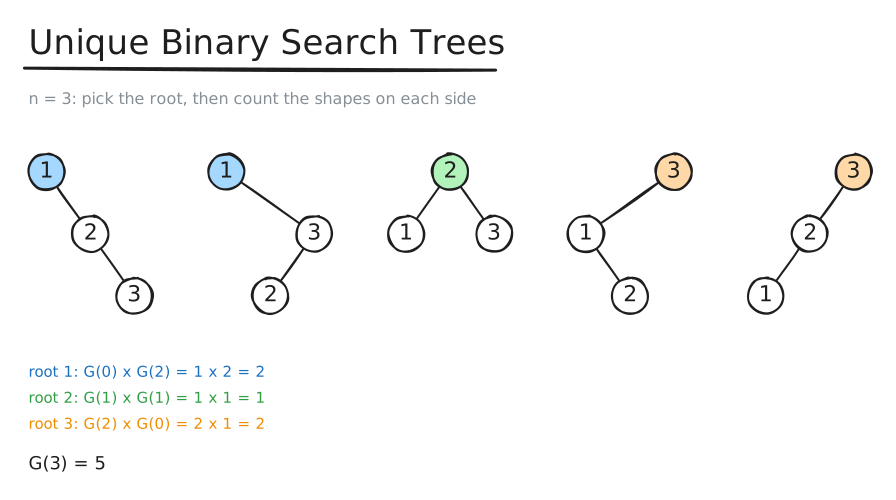
n = 3  ->  5
n = 4  ->  14
n = 19 -> 1767263190Choose the root value r. Then 1..r−1 must form the left subtree and r+1..n the right one, and any left shape combines with any right shape. The number of shapes depends only on how many values a side has, not which ones. So with G(k) = the number of BSTs on k values:
G(0) = 1                      (the empty tree is one shape)
G(n) = sum over r = 1..n of  G(r - 1) * G(n - r)
These are the Catalan numbers: 1, 1, 2, 5, 14, 42, 132, …
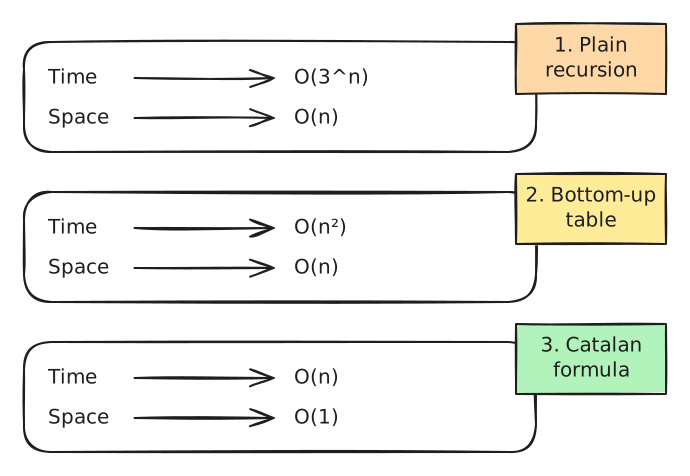
function numTrees(n) { if (n <= 1) return 1; let total = 0; for (let r = 1; r <= n; r++) total += numTrees(r - 1) * numTrees(n - r); // left shapes x right shapes return total;}Time O(3ⁿ) — the same G(k) is recomputed over and over — space O(n).
G[k] is filled from smaller sizes: every root splits k values into a left and a right part.
function numTrees(n) { const G = new Array(n + 1).fill(0); G[0] = 1; G[1] = 1; for (let k = 2; k <= n; k++) { // k values for (let r = 1; r <= k; r++) G[k] += G[r - 1] * G[k - r]; } return G[n];}Time O(n²), space O(n).
G(n) = C(2n, n) / (n + 1), and successive Catalan numbers satisfy G(i+1) = G(i) · 2(2i + 1) / (i + 2). Multiply before dividing — the division is always exact.
function numTrees(n) { let g = 1; // G(0) for (let i = 0; i < n; i++) g = (g * 2 * (2 * i + 1)) / (i + 2); return Math.round(g);}Time O(n), space O(1). Use 64-bit numbers: the product before dividing outgrows 32 bits long before the answer does.