The problem. There are n cities. isConnected[i][j] is 1 when city i and city j are joined by a direct road, 0 otherwise. A province is a group of cities that can reach each other, directly or through other cities, and no city outside the group. Return the number of provinces.
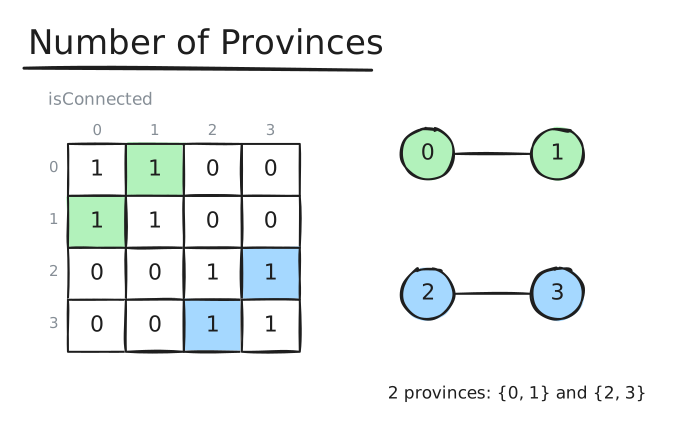
isConnected = [[1,1,0],[1,1,0],[0,0,1]]   ->  2     (cities 0 and 1 together; 2 alone)
isConnected = [[1,0,0],[0,1,0],[0,0,1]]   ->  3     (no roads: every city alone)
isConnected = [[1,1,0],[1,1,1],[0,1,1]] -> 1 (0-1 and 1-2: one chain)Cities are vertices and roads are edges, so a province is a connected component. This time the graph comes as an adjacency matrix: row i lists every city, with 1 under the ones joined to i. Counting components is the same move as counting islands — start a walk from each city nobody has reached yet, and count the walks.
Each walk colours one province. Try a matrix with no roads, or one long chain.
function findCircleNum(isConnected) { const n = isConnected.length; const visited = new Array(n).fill(false); const visit = (city) => { visited[city] = true; for (let other = 0; other < n; other++) { if (isConnected[city][other] === 1 && !visited[other]) visit(other); // a road to someone new } }; let provinces = 0; for (let city = 0; city < n; city++) { if (!visited[city]) { // no walk has reached this city: a new province provinces++; visit(city); // mark every city it can reach } } return provinces;}Time O(n²), space O(n). Each city is visited once, and visiting it reads its whole row of the matrix — n cells. The visited array and the recursion hold at most n cities.
A completely different way to count groups, and a preview of Pattern 7. Start with every city as its own group, so there are n provinces. Then look at each road: if its two cities are in different groups, merge the groups — one province fewer. Each group has a leader; find(x) follows parent links up to it.
function findCircleNum(isConnected) { const n = isConnected.length; const parent = Array.from({ length: n }, (_, i) => i); // every city leads its own group const find = (x) => { while (parent[x] !== x) { parent[x] = parent[parent[x]]; // path halving: point closer to the leader as we go x = parent[x]; } return x; }; let provinces = n; for (let i = 0; i < n; i++) { for (let j = i + 1; j < n; j++) { // each road once (the matrix is symmetric) if (isConnected[i][j] !== 1) continue; const a = find(i), b = find(j); if (a !== b) { parent[a] = b; // merge the two groups... provinces--; // ...so there is one province fewer } } } return provinces;}Time O(n² log n) at worst, space O(n). Reading the matrix is O(n²); with path halving each find is at most O(log n) and usually close to constant. Pattern 7 adds union by rank, which makes every operation nearly O(1).
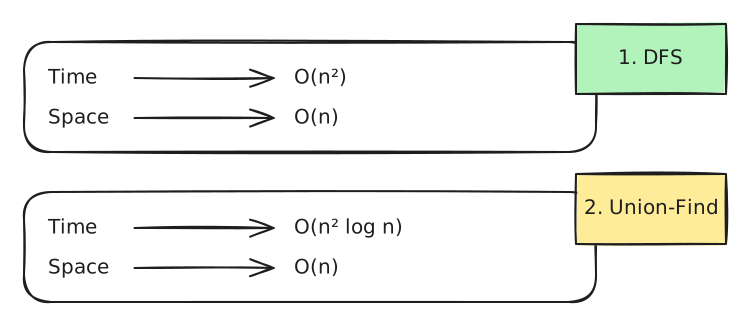
Here DFS is simpler and at least as fast, because every road is known up front. Union-Find wins when roads arrive one at a time and you must report the count after each — no walk has to be redone.
[[1]] is 1 province.a == b merges two letters' groups; then every a != b must be in different groups. Union-Find again.