The problem. Given an array nums, rearrange its values in place so that it becomes a valid min-heap — every parent nums[i] is less than or equal to its children nums[2i + 1] and nums[2i + 2] — and return it. Any valid heap is accepted.
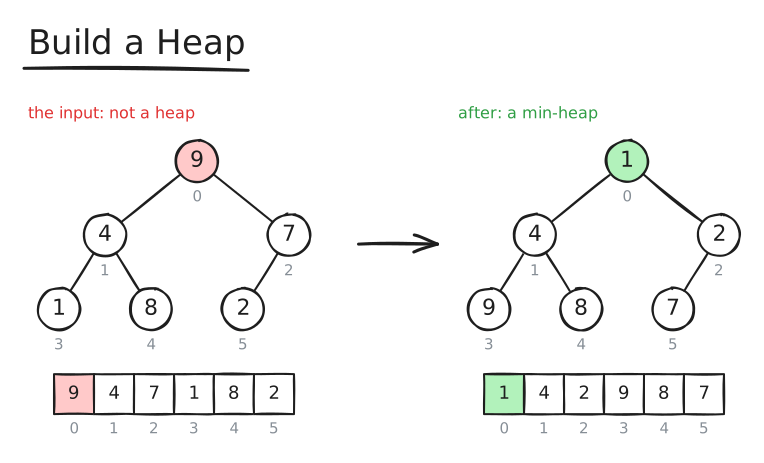
nums = [9, 4, 7, 1, 8, 2]   ->  [1, 4, 2, 9, 8, 7]   (other valid heaps are fine too)
nums = [3, 2, 1]            ->  [1, 2, 3]
nums = [1, 2, 3, 4]         ->  [1, 2, 3, 4]         (already a heap: nothing moves)
Fun fact: a sorted array is always a valid min-heap — every parent sits at a smaller index than its children. So sorting solves this in O(n log n). The question is whether we can do better.
Free account
Sign up to read the rest of this lesson: 8 more sections, 4 drawings, a dry-run simulator and code in JavaScript, Python, Java and C++.
Still to come