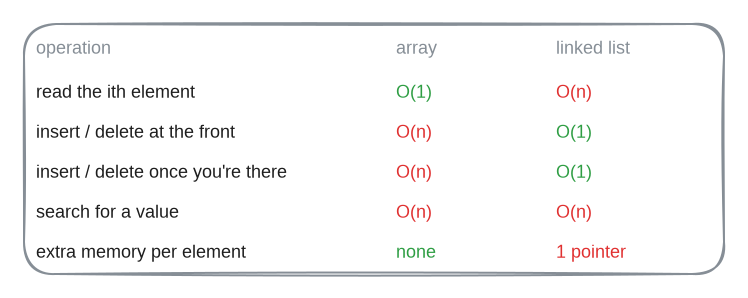
Arrays are fast and simple, so why invent anything else? Because arrays have one big weakness: their elements must sit side by side. Whenever you add or remove something anywhere except the end, the neighbours have to move. Linked lists exist to remove that cost.
Say you have [10, 20, 30, 40] and want to put 5 at the front. In an array there is no empty slot at index 0 — so every element has to move one place to the right first. Four elements means four moves; a million elements means a million moves.
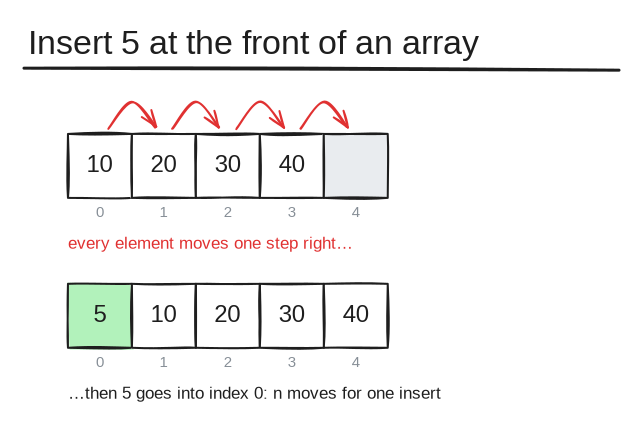
Count the moves: inserting one value at the front of an array touches every element.
In a linked list, nothing has to move. Create a new node anywhere in memory, point it at the old head, and call it the new head. That's two pointer changes, whether the list has 4 nodes or 4 million.
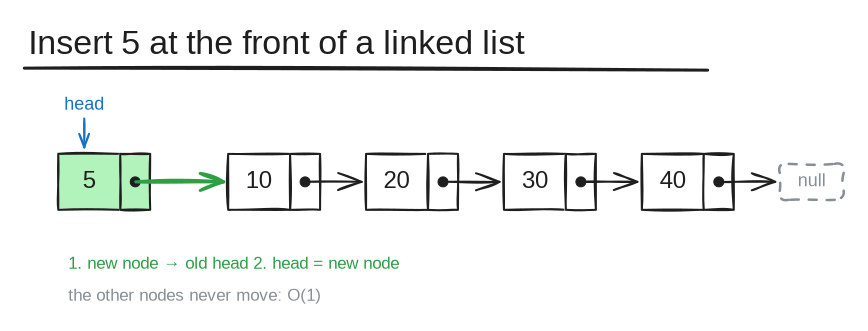
Two steps, no matter how long the list is.
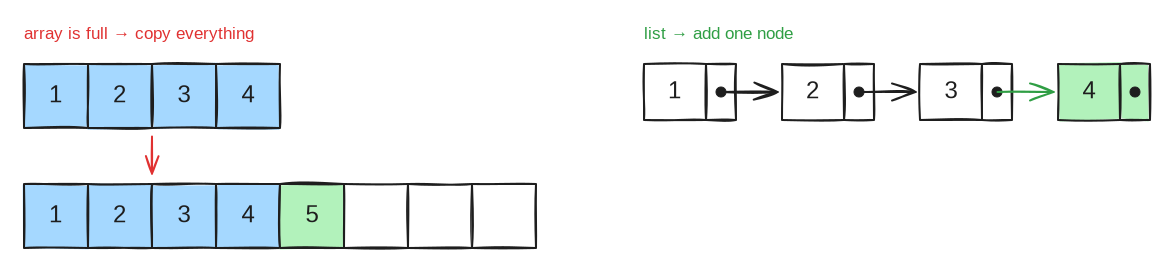
An array is created with a fixed amount of room. When it fills up, a growable array (JavaScript arrays, Python lists, Java's ArrayList, C++'s vector) has to grab a bigger block and copy every element into it. A linked list never runs out of room in that way: each new node is just one more small allocation.
Linked lists aren't free. The same arrows that make inserting cheap cause three costs:
arr[500] is instant; reaching the 500th node means following 500 arrows — O(n).