The problem. nums1 has length m + n: its first m values are sorted, and the last n slots are empty (zeros). nums2 holds n sorted values. Merge nums2 into nums1 in place so that nums1 becomes one sorted array. Return nothing.
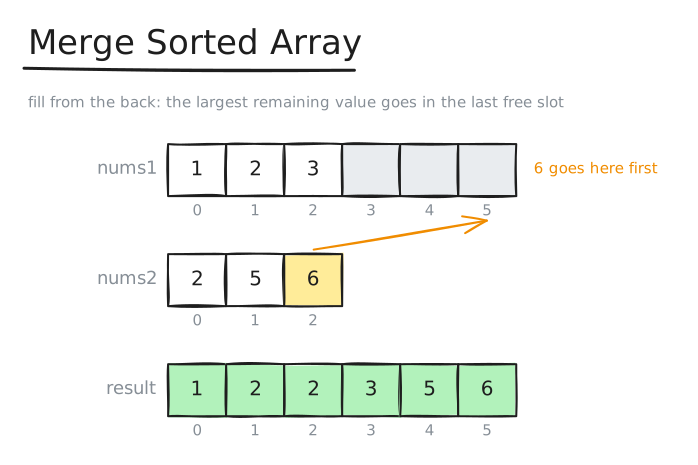
nums1 = [1,2,3,0,0,0], m = 3, nums2 = [2,5,6], n = 3  ->  nums1 = [1,2,2,3,5,6]
nums1 = [1], m = 1, nums2 = [], n = 0                ->  nums1 = [1]
nums1 = [0], m = 0, nums2 = [1], n = 1 -> nums1 = [1]Merge sort's merge step — walk two sorted lists, repeatedly taking the smaller front value — is worth knowing on its own. It merges sorted arrays and linked lists in linear time, and because both halves are sorted while merging, it can also count relationships between the halves that would otherwise take O(n²): inversions, reverse pairs, smaller numbers after each value. This chapter goes from the plain merge to those counting tricks.
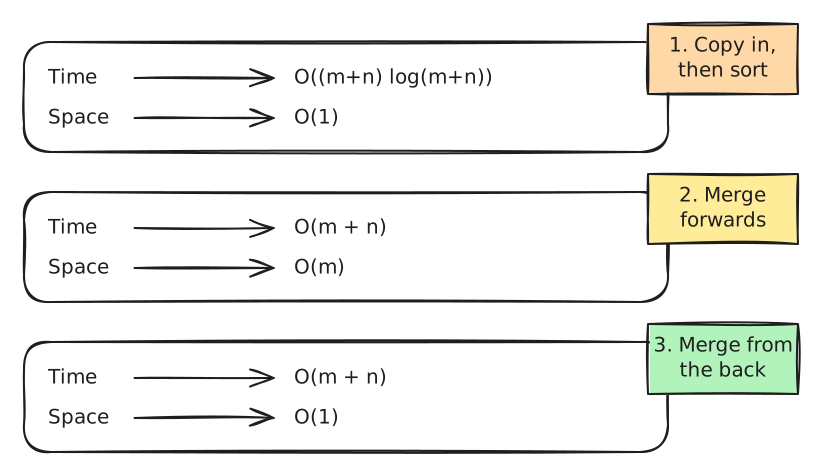
function merge(nums1, m, nums2, n) { for (let j = 0; j < n; j++) nums1[m + j] = nums2[j]; // fill the empty slots nums1.sort((a, b) => a - b);}Time O((m + n) log(m + n)), space O(1) beyond the sort. It ignores that both inputs are already sorted.
function merge(nums1, m, nums2, n) { const first = nums1.slice(0, m); // save nums1's values before overwriting let i = 0, j = 0, k = 0; while (i < m && j < n) nums1[k++] = first[i] <= nums2[j] ? first[i++] : nums2[j++]; while (i < m) nums1[k++] = first[i++]; while (j < n) nums1[k++] = nums2[j++];}Time O(m + n), space O(m). A normal merge — but merging into the front of nums1 would overwrite values not yet used, hence the copy.
The largest remaining value goes into the last free slot, so nothing unread is ever overwritten.
function merge(nums1, m, nums2, n) { let i = m - 1; let j = n - 1; let k = m + n - 1; while (j >= 0) { if (i >= 0 && nums1[i] > nums2[j]) { nums1[k] = nums1[i]; i--; } else { nums1[k] = nums2[j]; j--; } k--; }}Time O(m + n), space O(1). Writing from the back is safe: k is always at or beyond i, so a slot is only overwritten once its value has been moved. When nums2 runs out, the rest of nums1 is already in place — that's why the loop only runs while j >= 0.
[4,5,6,0,0,0] and [1,2,3]: nums1's values all shift to the back.