In JavaScript, Python and Java, a string is immutable: once it exists, its characters can never change. Every operation that seems to change a string — upper-casing, replacing, appending — actually builds a new string and leaves the old one untouched. C++ is the exception: a std::string can be edited in place.
s = "hello"; then try s[0] = 'J'

JavaScript   s[0] = "J"   is silently ignored (a TypeError in strict mode); s is still "hello"
Python       s[0] = "J"   raises TypeError: 'str' object does not support item assignment
Java         there is no method that sets a character; s.replace(...) returns a new String
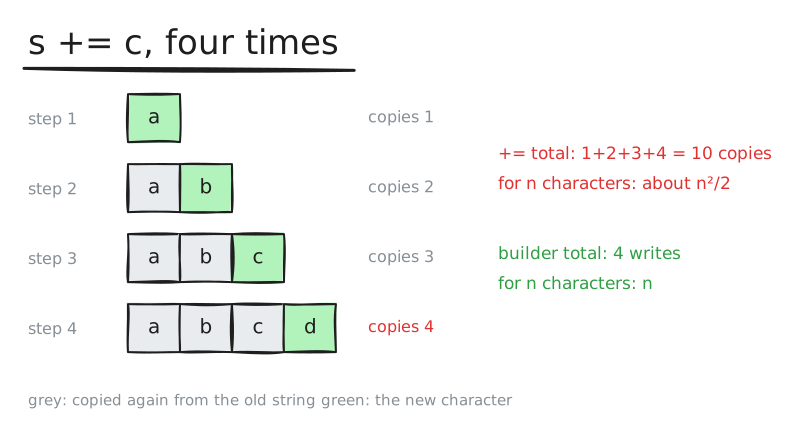
C++ s[0] = 'J'; works: s is now "Jello""OK" can share one object in memory (Java calls this the string pool).Because a string can't grow, s += piece must allocate a new string and copy the whole of s into it, then the piece. Do that in a loop and the copying adds up: building a string of n characters one at a time copies 1 + 2 + 3 + … + n characters — about n² / 2. That's O(n²) for what looks like a simple loop.
Some runtimes soften this — modern JavaScript engines and CPython can sometimes extend a string in place — but neither guarantees it, and Java's += in a loop really does copy each time. In an interview, assume += on a string in a loop is O(n²).
The fix is the same idea in every language: collect the pieces in something that can grow cheaply, then make the final string once.
parts.join("")."".join(parts).StringBuilder: append(...) is amortized O(1), like ArrayList.add, and toString() copies once at the end.std::string itself is the builder: s += piece and s.push_back(c) append in place, amortized O(1). (But s = s + piece still builds a full temporary copy.)Here are both ways of joining words with single spaces. (Each language also has a one-liner — words.join(" "), " ".join(words), String.join(" ", words) — which builds in O(n) exactly like approach 2.)
Every += makes a whole new string. Watch the copy counter grow faster than the string.
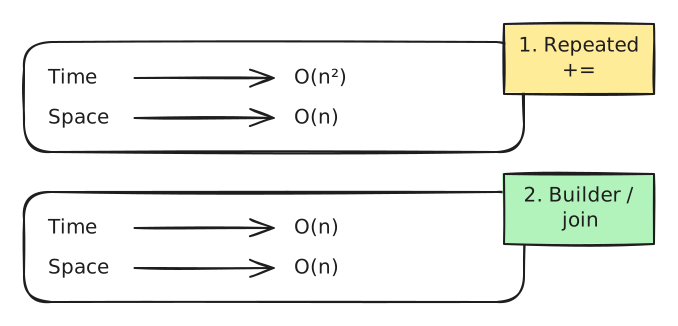
function joinWords(words) { let s = ""; for (let i = 0; i < words.length; i++) { if (i > 0) s += " "; s += words[i]; // a new string each time: copies everything so far } return s;}Time O(n²), space O(n) for a result of n characters: every append copies all the characters so far.
function joinWords(words) { const parts = []; for (let i = 0; i < words.length; i++) { if (i > 0) parts.push(" "); parts.push(words[i]); // O(1): just remember the piece } return parts.join(""); // one pass copies each character once}Time O(n), space O(n). Each character is written into the buffer once (plus the occasional doubling of the buffer, which averages out to O(1) per character), and copied once more at the end.
When a question asks you to modify a string in place — reverse it, swap characters, replace some — turn it into an array of characters first, change the array, and turn it back at the end:
JavaScript   const a = [...s];        ... a[i] = x ...   a.join("")
Python       a = list(s)              ... a[i] = x ...   "".join(a)
Java         char[] a = s.toCharArray();  ... a[i] = x ...   new String(a)
C++          s[i] = x;                (std::string is already mutable)
Converting costs O(n) once, and every change after that is O(1). Many interview questions skip this step by handing you the characters as an array already — Reverse String in the next chapter is one.
