Hundreds of array problems are solved with fewer than ten techniques. The skill interviewers are really testing is recognition: reading a problem and thinking "this smells like a sliding window". This lesson is your map; under each technique are the interview questions in this course that use it.
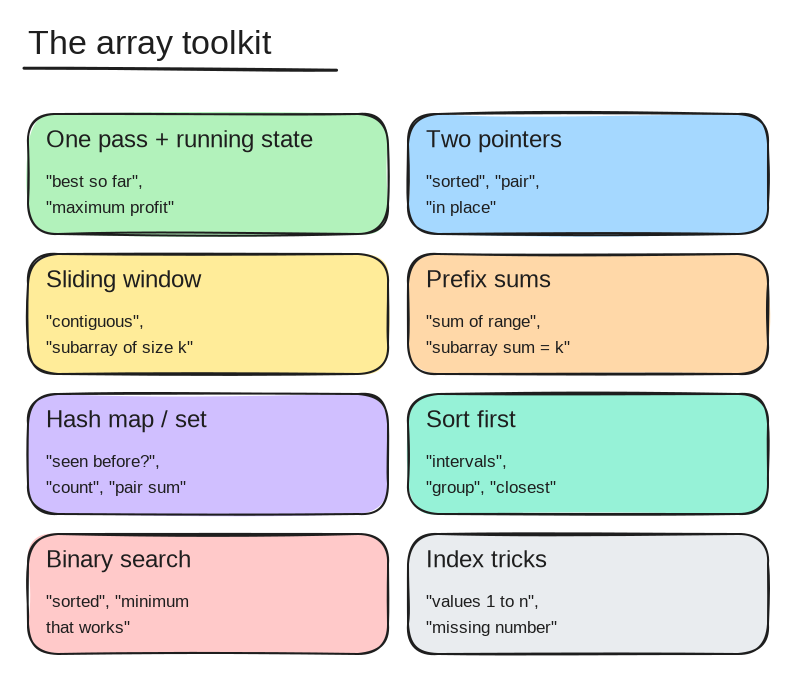
Walk the array once and keep a few variables up to date: the best so far, the cheapest so far, a running sum, a counter. Signals: a single answer about the whole array; "maximum", "minimum", "best time".
Two indexes moving through the array — from both ends toward the middle, or one reading and one writing. Signals: a sorted array, pairs or triplets, palindromes, "in place", "remove", "partition".
A range [left, right] that slides along the array, adding the element entering and removing the one leaving, instead of recomputing the whole range. Signals: "contiguous subarray", "substring", "window of size k", "longest / shortest subarray such that…".
Precompute running totals so that the sum of any range is one subtraction. Signals: many range-sum questions, "subarray sum equals k", "everything to my left / right".
Trade memory for speed: remember what you've seen so that "have I seen x?" costs O(1). Signals: "pair that sums to target", "duplicates", "frequency", "first unique", unsorted input where sorting would lose information (like original indexes).
Sorting costs O(n log n), but afterwards equal values sit together, intervals line up by start, and the smallest and largest are at the ends. Signals: intervals and meetings, grouping, "closest", when the original order doesn't matter.
Halve the search space each step. Works on sorted values — and, more surprisingly, on any yes/no question that flips once ("can we finish with capacity c?"). Signals: sorted input, "O(log n)", "minimum capacity / speed / time such that…".
When values are in the range 1..n, a value can point at an index: place each number at its "home" slot, or mark slots by flipping signs. Signals: "numbers from 1 to n", "missing", "duplicate", "O(1) extra space".
When you read a new problem: write the brute force first, then scan this list and ask "which of these removes the repeated work?" If two nested loops are searching for something, a hash map or two pointers usually removes the inner loop. If you keep re-adding the same range, it's a sliding window or prefix sums. If the input is sorted and you're not using that, you're probably missing two pointers or binary search.