The problem. Two players take turns removing one number from either end of the array nums, adding it to their own score. Player 1 goes first, and both play as well as possible. Return true if Player 1 can win or tie.
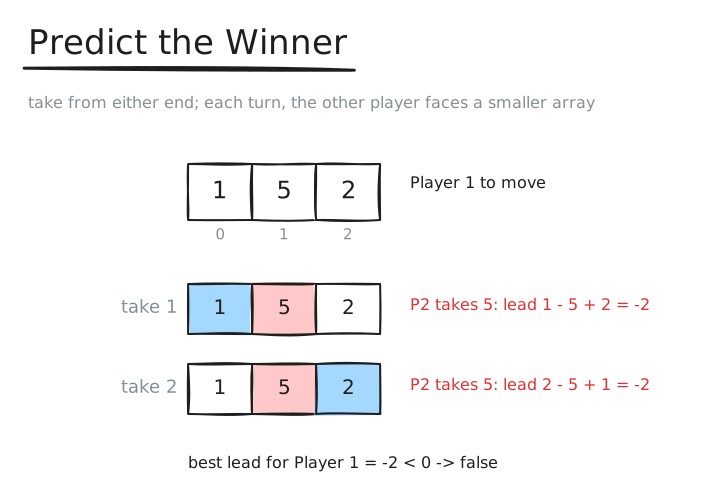
nums = [1, 5, 2]       ->  false   (Player 2 always gets the 5)
nums = [1, 5, 233, 7]  ->  true    (take 1; whatever Player 2 takes, 233 is reachable)
nums = [7] -> trueDefine lead(l, r) = the most the player about to move can end up ahead by, playing on nums[l..r]. If they take nums[l], the opponent then moves on nums[l+1..r] and gets a lead of lead(l + 1, r) over them — so their lead is nums[l] − lead(l + 1, r). Taking nums[r] works the same way. They pick the better: lead(l, r) = max(nums[l] − lead(l+1, r), nums[r] − lead(l, r−1)). With one number left, the lead is that number. Player 1 wins or ties when lead(0, n−1) >= 0. Thinking in leads means one function serves both players.
The game tree: each node is a range still in play; its lead comes from its two children.
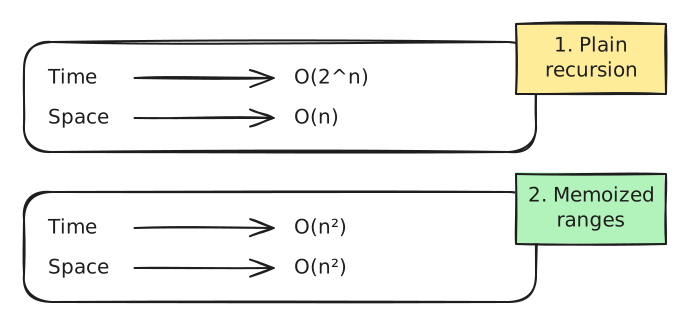
function predictTheWinner(nums) { const lead = (l, r) => { // best lead for whoever moves on nums[l..r] if (l === r) return nums[l]; // one number left: take it const takeLeft = nums[l] - lead(l + 1, r); // the opponent then leads by lead(l+1, r) const takeRight = nums[r] - lead(l, r - 1); return Math.max(takeLeft, takeRight); }; return lead(0, nums.length - 1) >= 0;}Time O(2ⁿ), space O(n). Every call branches twice. With n up to 20, that's about a million calls — acceptable here, but the same ranges are solved many times.
There are only n² different ranges (l, r). Store each lead the first time — top-down dynamic programming.
function predictTheWinner(nums) { const n = nums.length; const memo = Array.from({ length: n }, () => new Array(n).fill(null)); const lead = (l, r) => { if (l === r) return nums[l]; if (memo[l][r] !== null) return memo[l][r]; // this range was solved before memo[l][r] = Math.max(nums[l] - lead(l + 1, r), nums[r] - lead(l, r - 1)); return memo[l][r]; }; return lead(0, n - 1) >= 0;}Time O(n²), space O(n²). A bottom-up table filled by range length reaches the same time with O(n) memory — the interval pattern in the Dynamic Programming course.
[1, 1]: equal scores count as a win for Player 1.[0, 0, 7, 0].