When a function calls another function, the computer has to remember where it was — the caller's local variables and the line to come back to. It keeps that in a stack frame, and the frames live on the call stack: each call pushes a frame, each return pops one. Recursion is just a function whose frames happen to belong to itself.
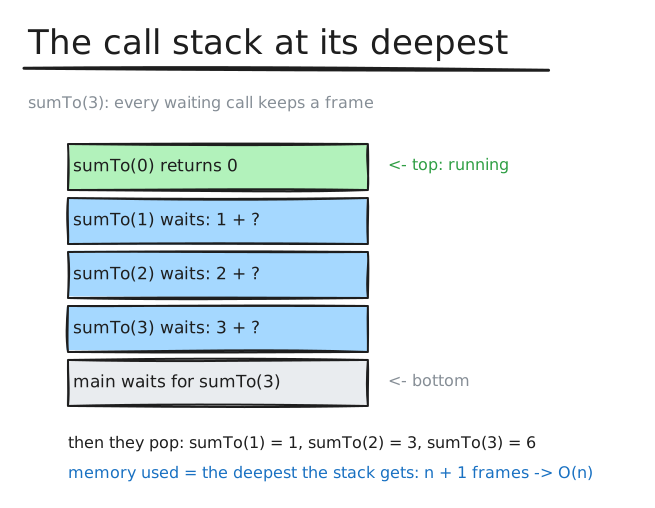
return, the frame is thrown away and its value is handed to the caller, which carries on from where it paused.Watch the frames pile up on the way down and pop on the way back.
Each frame costs a little memory — tens of bytes for a small function. What matters is how many frames are alive at the same time, which is the depth of the recursion, not the total number of calls:
sumTo(n)       n + 1 calls in total, n + 1 alive at once     space O(n)
fib(n)         about 2^n calls in total, only n alive at once  space O(n)
binarySearch   log n calls, log n alive at once            space O(log n)
merge sort     about 2n calls, log n deep                  space O(log n) stack + O(n) for merging
So when you state a recursive algorithm's space, count the maximum depth times the memory per frame, plus anything the function allocates. A loop doing the same job usually needs O(1).
The call stack is small — a few megabytes. Go too deep and the program crashes: RangeError: Maximum call stack size exceeded in JavaScript, RecursionError in Python (whose default limit is only 1,000 calls), StackOverflowError in Java, and a segmentation fault in C++. Roughly 10,000 frames is a safe ceiling in most languages. That's why recursion over a list of a million values is a bad idea, while recursion over a balanced tree (depth about 20) is fine.
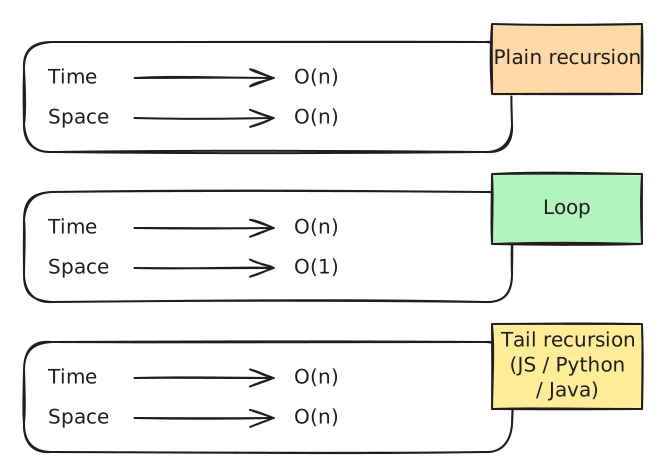
The same sum, three ways: plain recursion, a loop, and tail recursion, where the recursive call is the very last thing the function does and the running total is carried along in a parameter.
function sumTo(n) { if (n === 0) return 0; // base case return n + sumTo(n - 1); // waits for sumTo(n - 1), then adds n}function sumTo(n) { let total = 0; for (let i = 1; i <= n; i++) total += i; // no calls, one frame return total;}function sumTo(n, total = 0) { if (n === 0) return total; return sumTo(n - 1, total + n); // tail call: nothing left to do after it}A tail call leaves nothing for the caller to do, so a compiler could reuse the caller's frame and run it in O(1) space. Scheme and some C++ optimisers do; JavaScript engines, Python and Java don't. In those languages, a tail-recursive function is still O(n) deep — rewrite it as a loop when the depth can be large.