The problem. prices[i] is a stock's price on day i. Make as many buy-then-sell transactions as you like, holding at most one share at a time — but after you sell, you can't buy on the next day (a one-day cooldown). Return the maximum profit.
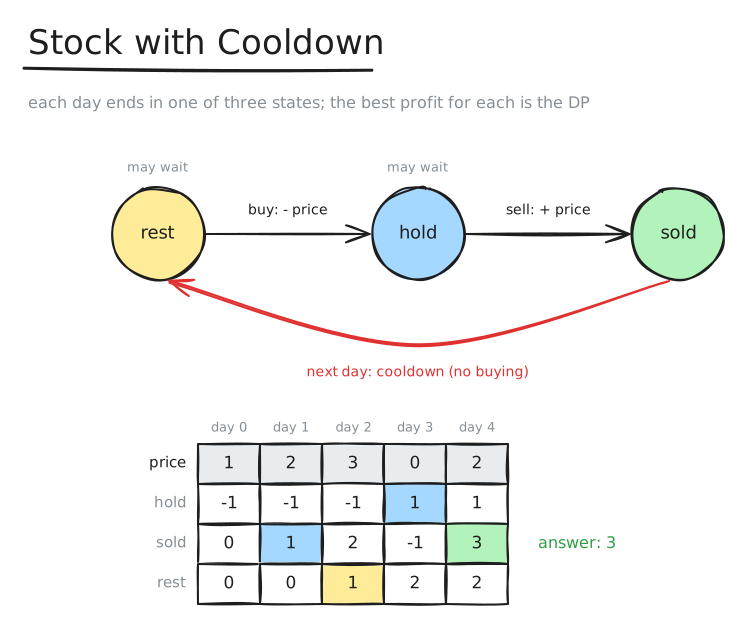
prices = [1, 2, 3, 0, 2]  ->  3   (buy 1, sell 2, cooldown, buy 0, sell 2)
prices = [1]              ->  0
prices = [3, 2, 1]        ->  0   (never buy)
prices = [1, 4, 2] -> 3 (buy 1, sell 4)At the end of each day you're in exactly one of three situations: hold (you own a share), sold (you sold today, so tomorrow is a cooldown) or rest (no share and free to buy). Keep the best profit for each. The moves between them are the whole problem:
max(hold, rest - price). Buying from sold isn't allowed — that's the cooldown.hold + price.max(rest, sold).The answer is the better of ending in sold or rest — never in hold, since a share you still own earned nothing. This state machine view works for the whole stock family: add a fee, cap the transactions, and so on.
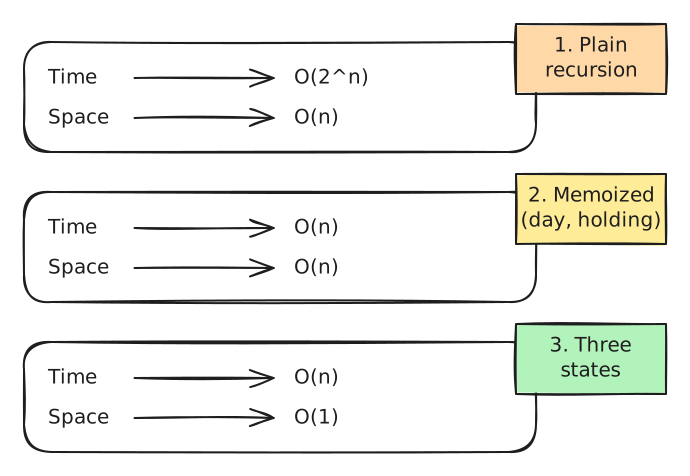
function maxProfit(prices) { const best = (day, holding) => { // the most profit from day on if (day >= prices.length) return 0; const wait = best(day + 1, holding); // do nothing today if (holding) return Math.max(wait, prices[day] + best(day + 2, false)); // sell; tomorrow is cooldown return Math.max(wait, -prices[day] + best(day + 1, true)); // buy }; return best(0, false);}Time O(2ⁿ), space O(n). Selling jumps two days ahead — that's the cooldown, built into the recursion. But there are only 2n different (day, holding) pairs.
function maxProfit(prices) { const memo = new Map(); // day * 2 + holding -> best profit const best = (day, holding) => { if (day >= prices.length) return 0; const key = day * 2 + (holding ? 1 : 0); if (memo.has(key)) return memo.get(key); let result = best(day + 1, holding); // do nothing today if (holding) result = Math.max(result, prices[day] + best(day + 2, false)); // sell; tomorrow is cooldown else result = Math.max(result, -prices[day] + best(day + 1, true)); // buy memo.set(key, result); return result; }; return best(0, false);}Time O(n), space O(n). The recursion goes up to n calls deep; with LeetCode's 5,000 days that's past Python's default limit of 1,000 frames. The three-state loop below has no such limit.
Each day updates hold, sold and rest from yesterday's values.
function maxProfit(prices) { let hold = -prices[0], sold = 0, rest = 0; // best profit ending the day holding / having just sold / resting for (const p of prices) { const prevSold = sold; sold = hold + p; // sell the share we held hold = Math.max(hold, rest - p); // keep it, or buy: only from rest, never right after a sale rest = Math.max(rest, prevSold); // yesterday's sale makes today a cooldown } return Math.max(sold, rest);}Time O(n), space O(1). The order matters: sold and hold both read yesterday's hold, and rest reads yesterday's sold, so update sold before hold and save the old sold first. Starting with hold = -prices[0] means "bought on day 0"; selling it the same day just gives 0.
[1, 2, 3, 0, 2]: 3, while two back-to-back trades would give 4 without the rule.