The problem. Given an integer array nums, find the contiguous subarray with the largest product and return that product.
nums = [2, 3, -2, 4]      ->  6     ([2, 3])
nums = [-2, 0, -1]        ->  0
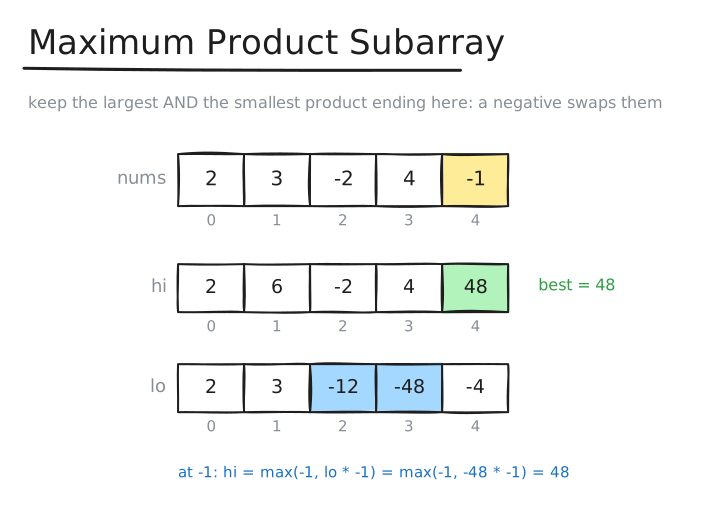
nums = [2, 3, -2, 4, -1]  ->  48    (the whole array: two negatives cancel)
nums = [-2, 3, -4] -> 24Pattern 5 problems carry more than one number per position: here the best and the worst product ending at i; in the stock problem, holding / just sold / resting; in the interval problems, a whole range [i, j]. The trick is always to find the few states that make the next step decidable.
For sums, Kadane's algorithm keeps one number: the best sum ending here. Products break that: a big negative product is one negative number away from being the biggest positive one. So keep two: hi, the largest product of a subarray ending at i, and lo, the smallest. For the next number x, the new extremes come from three candidates — x alone, hi · x and lo · x. When x is negative, the old lo produces the new hi, so just swap them first. A zero resets both to 0, and the next number starts fresh.
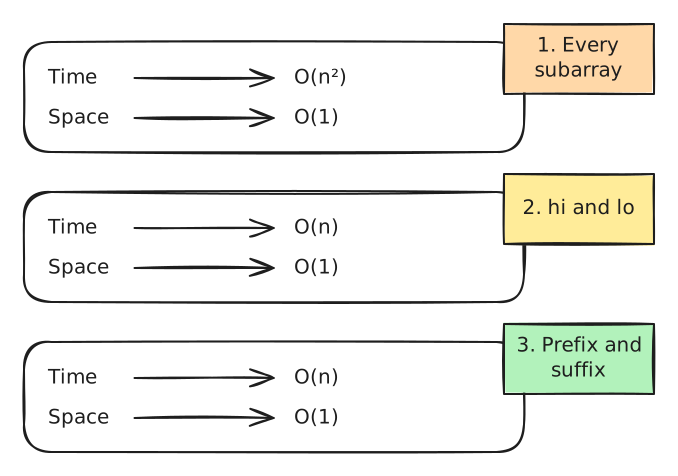
function maxProduct(nums) { let best = -Infinity; for (let i = 0; i < nums.length; i++) { let product = 1; for (let j = i; j < nums.length; j++) { product *= nums[j]; // product of nums[i..j] best = Math.max(best, product); } } return best;}Time O(n²), space O(1). Each start extends its product one number at a time instead of recomputing it.
Track the largest and smallest product ending at each index; a negative swaps them.
function maxProduct(nums) { let hi = nums[0], lo = nums[0], best = nums[0]; // largest and smallest product ending here for (let i = 1; i < nums.length; i++) { const x = nums[i]; if (x < 0) [hi, lo] = [lo, hi]; // a negative turns the smallest into the largest hi = Math.max(x, hi * x); // start fresh at x, or extend lo = Math.min(x, lo * x); best = Math.max(best, hi); } return best;}Time O(n), space O(1). This is the DP: two states per index, each computed from the two before it. It's the answer to give.
Another way to see it. Inside a stretch with no zeros, if the count of negatives is even, the whole stretch is best. If it's odd, you must drop one negative — and everything on one side of it — so the best is a prefix or a suffix of the stretch. Scanning from both ends, and restarting after each zero, sees all of them.
function maxProduct(nums) { const n = nums.length; let best = -Infinity, left = 1, right = 1; for (let i = 0; i < n; i++) { left = (left === 0 ? 1 : left) * nums[i]; // prefix product, restarting after a zero right = (right === 0 ? 1 : right) * nums[n - 1 - i]; // suffix product, the same from the right best = Math.max(best, left, right); } return best;}Time O(n), space O(1). Short and clever, but harder to justify on the spot than the hi/lo version.
[-2]: the answer is -2, not 0. Start best at nums[0], not 0.[-2, 0, -1]: 0. A zero splits the array into separate stretches.[-2, 3, -4]: 24, the whole array.[2, -5, -2, -4, 3]: 24, dropping the first two numbers.