The problem. Houses along a street hold nums[i] money each. Robbing two adjacent houses sets off the alarm. Return the most money you can rob without robbing two neighbours.
nums = [1, 2, 3, 1]     ->  4    (rob houses 0 and 2)
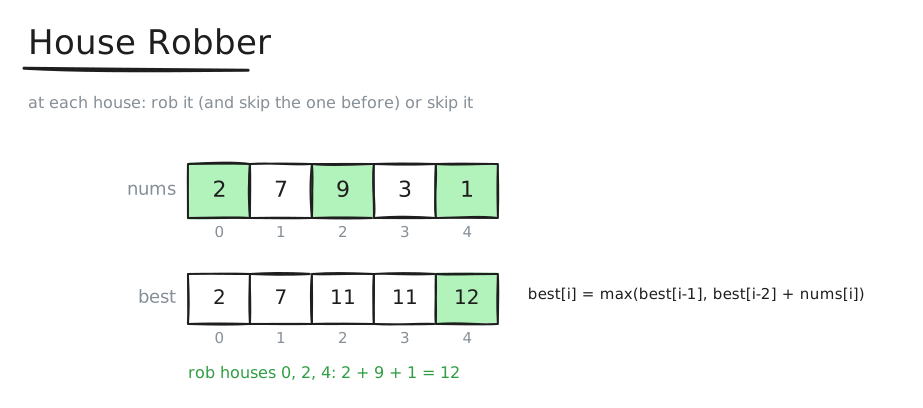
nums = [2, 7, 9, 3, 1]  ->  12   (rob houses 0, 2 and 4)
nums = [2, 1, 1, 2] -> 4 (rob houses 0 and 3)Let best[i] be the most you can rob from houses 0..i. For house i there are two choices. Skip it: you keep best[i − 1]. Rob it: you get nums[i], but house i − 1 must be skipped, so add best[i − 2]. Take the better: best[i] = max(best[i − 1], best[i − 2] + nums[i]). Greedy rules like "take every other house" fail — [2, 1, 1, 2] needs houses 0 and 3.
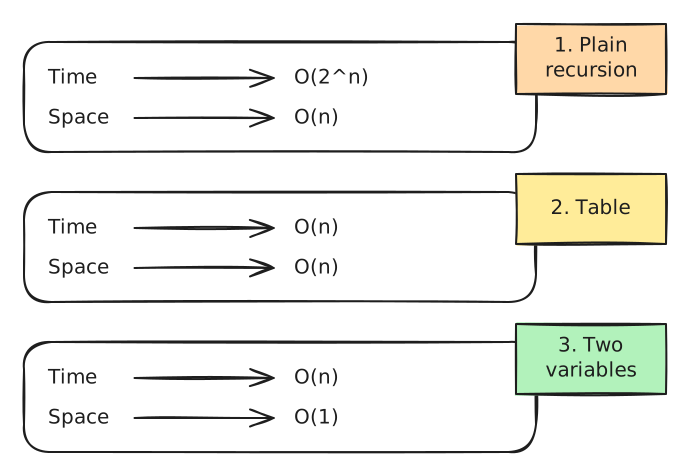
function rob(nums) { const best = (i) => { // the most from houses 0..i if (i < 0) return 0; // no houses left return Math.max(best(i - 1), best(i - 2) + nums[i]); // skip house i, or rob it }; return best(nums.length - 1);}Time O(2ⁿ), space O(n).
Each house compares robbing it (plus the best from two houses back) with skipping it.
function rob(nums) { const n = nums.length; const best = new Array(n).fill(0); // best[i]: the most from houses 0..i for (let i = 0; i < n; i++) { const skip = i >= 1 ? best[i - 1] : 0; // leave house i alone const take = nums[i] + (i >= 2 ? best[i - 2] : 0); // rob it: house i - 1 must be skipped best[i] = Math.max(skip, take); } return best[n - 1];}Time O(n), space O(n).
function rob(nums) { let twoBack = 0, oneBack = 0; // best[i - 2], best[i - 1] for (const money of nums) { [twoBack, oneBack] = [oneBack, Math.max(oneBack, twoBack + money)]; } return oneBack;}Time O(n), space O(1). Starting both variables at 0 handles the first two houses with no special cases.
[2, 1, 1, 2]: 4, which alternating misses.