The problem. Balloons in a row have numbers nums[i]. Bursting balloon i earns left · nums[i] · right, where left and right are its current neighbours (a missing neighbour counts as 1); then it's gone and its neighbours become adjacent. Burst them all. Return the most coins you can collect.
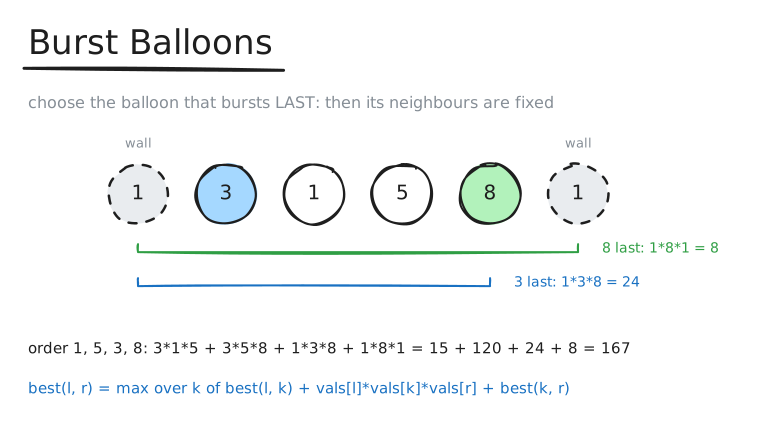
nums = [3, 1, 5, 8]  ->  167   (burst 1, 5, 3, 8)
nums = [1, 5]        ->  10    (burst 1: 1*1*5, then 5: 1*5*1)
nums = [7]           ->  7
The obvious recursion picks the first balloon to burst. But then its two neighbours become adjacent, so the left part and the right part are no longer separate problems — the state would have to be the whole set of balloons left, 2ⁿ of them.
Flip it: pick the balloon k that bursts last in a range. While k is still standing, it separates the balloons on its left from those on its right — they never become neighbours, so the two sides really are independent. And when k finally bursts, everything between l and r is gone, so its neighbours are exactly l and r. Pad the row with a 1 at each end, and let best(l, r) be the most coins from bursting every balloon strictly between l and r:
best(l, r) = max over l < k < r of   best(l, k) + vals[l] * vals[k] * vals[r] + best(k, r)
best(l, r) = 0 when nothing is between them (r - l < 2)
This is the hardest kind of interval DP: instead of shrinking from the ends, it tries every split point inside the range.
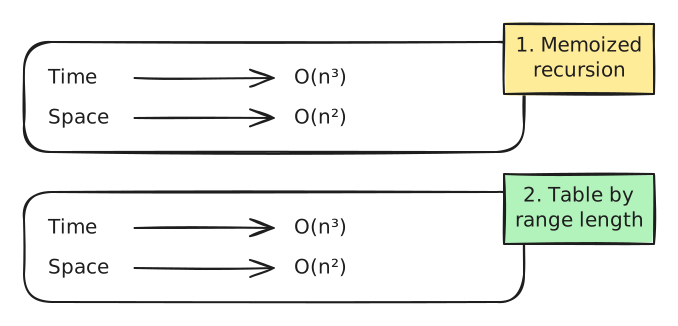
function maxCoins(nums) { const vals = [1, ...nums, 1]; // a 1 at each end: bursting next to a wall const memo = new Map(); const best = (l, r) => { // most coins for the balloons strictly between l and r if (r - l < 2) return 0; // nothing between them const key = l * vals.length + r; if (memo.has(key)) return memo.get(key); let most = 0; for (let k = l + 1; k < r; k++) { // k is the LAST balloon burst between l and r most = Math.max(most, best(l, k) + vals[l] * vals[k] * vals[r] + best(k, r)); } memo.set(key, most); return most; }; return best(0, vals.length - 1);}Time O(n³), space O(n²). There are O(n²) ranges and each tries O(n) last balloons. The recursion is only O(n) deep, since every call shrinks the range.
Fill ranges from short to long; each range tries every balloon inside it as the last to burst.
function maxCoins(nums) { const vals = [1, ...nums, 1]; const m = vals.length; // dp[l][r]: most coins for bursting every balloon strictly between l and r const dp = Array.from({ length: m }, () => new Array(m).fill(0)); for (let gap = 2; gap < m; gap++) { // shorter ranges first for (let l = 0; l + gap < m; l++) { const r = l + gap; for (let k = l + 1; k < r; k++) { // k bursts last, between l and r dp[l][r] = Math.max(dp[l][r], dp[l][k] + vals[l] * vals[k] * vals[r] + dp[k][r]); } } } return dp[0][m - 1];}Time O(n³), space O(n²). Every dp[l][k] and dp[k][r] covers a shorter range than dp[l][r], so filling by increasing gap guarantees they're ready. With LeetCode's n ≤ 300 that's about 4.5 million steps — fast.
The brute force — try every burst order — is O(n!), and choosing the first balloon gives no clean subproblems. The whole problem is the insight that the last balloon splits the range cleanly; say that first, and the code follows.
[7]: 1 · 7 · 1 = 7.[2, 2, 2]: 2·2·2 + 1·2·2 + 1·2·1 = 8 + 4 + 2 = 14.Was this helpful?
