The problem. Given a sorted array arr, and integers k and x, return the k values closest to x, sorted in ascending order. Value a is closer than b if |a − x| < |b − x|, or if they're equally far and a < b.
arr = [1, 2, 3, 4, 5], k = 4, x = 3      ->  [1, 2, 3, 4]
arr = [1, 1, 2, 3, 4, 5], k = 4, x = -1  ->  [1, 1, 2, 3]
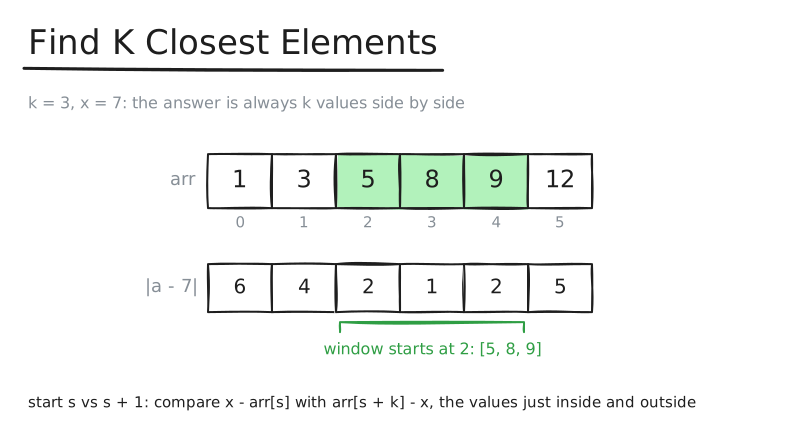
arr = [1, 3, 5, 8, 9, 12], k = 3, x = 7 -> [5, 8, 9]Because the array is sorted, the k closest values are always k neighbours — a window arr[s..s+k-1]. So the real question is the start s, somewhere in 0..n−k. Compare window s with window s + 1: they share everything except arr[s] (only in the first) and arr[s + k] (only in the second). If x − arr[s] > arr[s + k] − x, then arr[s] is farther away than arr[s + k], so the window should start later. Otherwise start s is at least as good. Those answers go "later, later, …, here or earlier" — binary search finds the first start that's good enough.
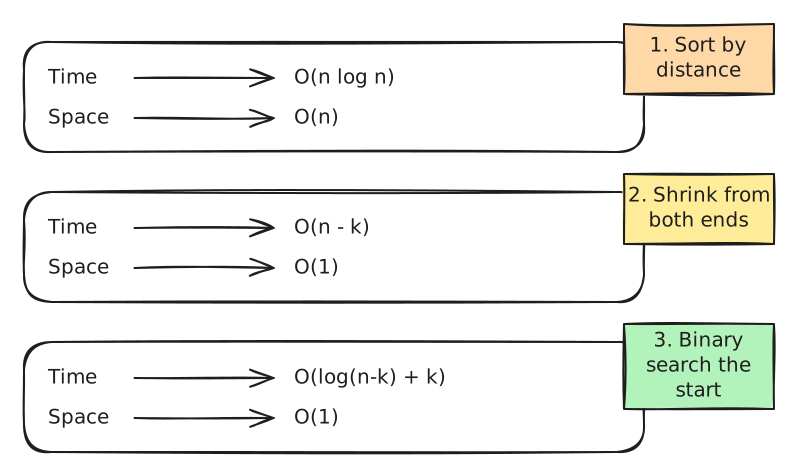
function findClosestElements(arr, k, x) { const byDistance = [...arr].sort((a, b) => Math.abs(a - x) - Math.abs(b - x) || a - b); // ties: smaller first return byDistance.slice(0, k).sort((a, b) => a - b);}Time O(n log n), space O(n). It throws away the fact that arr is already sorted.
function findClosestElements(arr, k, x) { let left = 0; let right = arr.length - 1; while (right - left + 1 > k) { if (x - arr[left] <= arr[right] - x) right--; // the right end is no closer: drop it (ties keep the smaller) else left++; // the left end is farther: drop it } return arr.slice(left, right + 1);}Time O(n − k), space O(1) besides the output. The farther of the two ends can never be among the k closest while the other end is still in.
Compare the value leaving the window with the one entering it, and halve the possible starts.
function findClosestElements(arr, k, x) { let low = 0; let high = arr.length - k; // the window arr[s..s+k-1] starts somewhere in 0..n-k while (low < high) { const mid = low + Math.floor((high - low) / 2); if (x - arr[mid] > arr[mid + k] - x) low = mid + 1; // arr[mid + k] is closer: start later else high = mid; // arr[mid] is at least as close: start here or earlier } return arr.slice(low, low + k);}Time O(log(n − k) + k), space O(1) besides the output. Compare the signed differences, not absolute values: with duplicates, |arr[mid] − x| > |arr[mid + k] − x| gives wrong answers when both values are equal but on the same side of x.
[1, 2, 3, 4, 5], k = 4, x = 3: 1 and 5 are equally far; keep the smaller, 1.[1, 1, 2, 3, 4, 5], x = −1: the absolute-value comparison breaks here.