The problem. Given a non-negative integer x, return the square root of x rounded down to the nearest integer. You may not use any built-in exponent function or operator such as Math.sqrt or x ** 0.5.
x = 4  ->  2
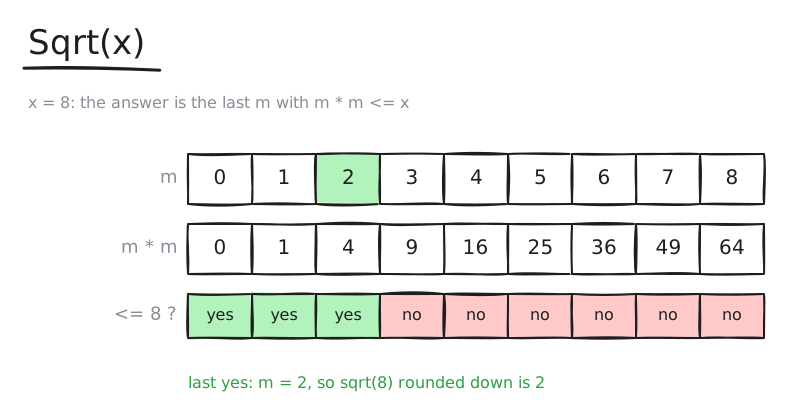
x = 8  ->  2   (the real root is 2.828...)
x = 0  ->  0
x = 2147483647  ->  46340
The answer is a whole number between 0 and x, and the question "is m * m <= x?" is yes for small m and no once m passes the root — it flips once. So binary search the candidates 0..x for the last yes. Each step halves the range, so even x = 2³¹ − 1 takes only about 31 steps. This is binary search on the answer in its simplest form.
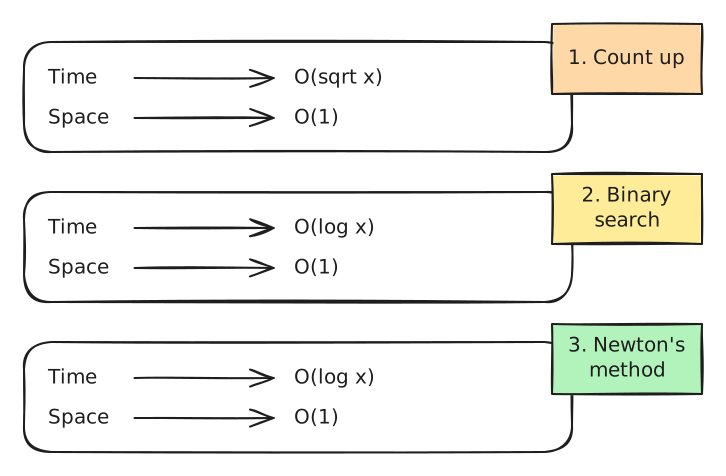
function mySqrt(x) { let k = 0; while ((k + 1) * (k + 1) <= x) k++; // grow k while the next square still fits return k;}Time O(√x), space O(1). About 46,000 steps for the largest input — fast enough here, but it doesn't scale.
If mid's square fits, remember mid and look higher; if not, look lower.
function mySqrt(x) { let low = 0; let high = x; let answer = 0; while (low <= high) { const mid = low + Math.floor((high - low) / 2); if (mid * mid <= x) { answer = mid; // mid fits: remember it, then look for a bigger one low = mid + 1; } else { high = mid - 1; // mid is too big } } return answer;}Time O(log x), space O(1). Keeping a separate answer is a handy way to find a last yes with the classic loop: every yes is a candidate, and the loop keeps looking right for a better one.
A different idea from numerical analysis: start with a guess r and replace it with the average of r and x / r. If r is too big, x / r is too small, and their average is much closer. In integers, repeat while r * r > x. It converges very fast — each step roughly doubles the number of correct digits.
function mySqrt(x) { let r = x; while (r * r > x) r = Math.floor((r + Math.floor(x / r)) / 2); // average r and x / r return r;}Time O(log x), space O(1) — and in practice fewer steps than binary search. Binary search is the expected interview answer; Newton's method is a great follow-up.
mid * mid overflows a 32-bit int; use 64 bits.mid * mid equals num exactly.