The problem. Given two sorted arrays nums1 and nums2 of sizes m and n, return the median of all their values together. The overall run time should be O(log(m + n)).
nums1 = [1, 3], nums2 = [2]           ->  2.0
nums1 = [1, 2], nums2 = [3, 4]        ->  2.5
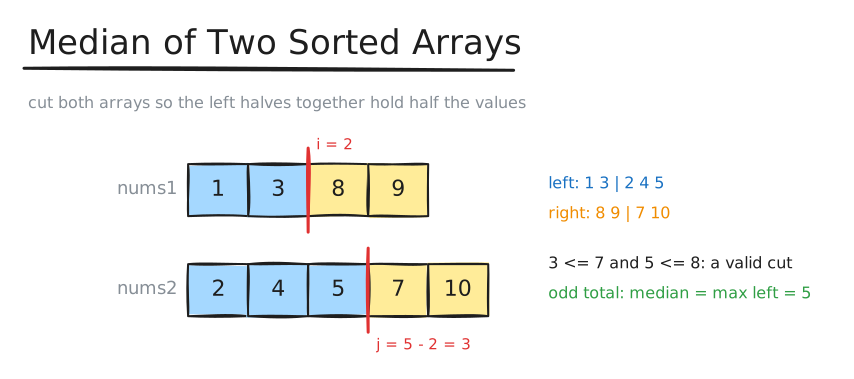
nums1 = [1, 3, 8, 9], nums2 = [2, 4, 5, 7, 10]  ->  5.0
The last two problems are the hardest binary searches interviews ask for. Neither searches for a value in an array. This one searches for a cut position that splits two arrays correctly; the next searches a range of distances, counting with two pointers at each step. Both still come down to the same question: which half of the search space can safely be thrown away?
The median splits all m + n values into a left half and a right half where every left value is at most every right value. Suppose the left half takes i values from nums1 and j from nums2, with i + j = half (half the total, rounded up). Because both arrays are sorted, the cut is correct exactly when nums1[i−1] <= nums2[j] and nums2[j−1] <= nums1[i] — the largest on each left side doesn't pass the smallest on the other right side. If nums1[i−1] is too big, i is too large; otherwise i is too small. That's a binary search on i alone. Search the shorter array so j always stays in range.
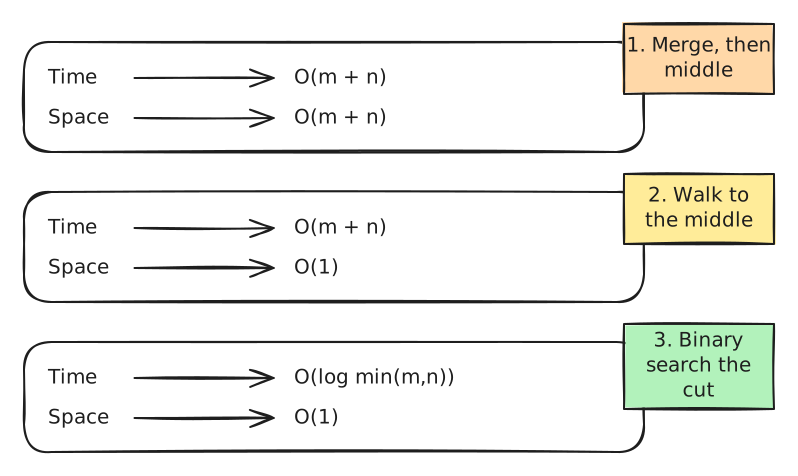
function findMedianSortedArrays(nums1, nums2) { const merged = []; let i = 0, j = 0; while (i < nums1.length || j < nums2.length) { if (j === nums2.length || (i < nums1.length && nums1[i] <= nums2[j])) merged.push(nums1[i++]); else merged.push(nums2[j++]); } const mid = Math.floor(merged.length / 2); return merged.length % 2 ? merged[mid] : (merged[mid - 1] + merged[mid]) / 2;}Time O(m + n), space O(m + n).
Only the one or two middle values matter, so run the merge's two pointers just far enough and remember the last two values passed.
function findMedianSortedArrays(nums1, nums2) { const total = nums1.length + nums2.length; let i = 0, j = 0, prev = 0, cur = 0; for (let step = 0; step <= Math.floor(total / 2); step++) { // walk to the middle prev = cur; if (j === nums2.length || (i < nums1.length && nums1[i] <= nums2[j])) cur = nums1[i++]; else cur = nums2[j++]; } return total % 2 ? cur : (prev + cur) / 2;}Time O(m + n), space O(1). A good first answer — then the interviewer asks for O(log).
Try a cut in the shorter array, take the rest from the longer one, and check the four values around the cuts.
function findMedianSortedArrays(nums1, nums2) { if (nums1.length > nums2.length) return findMedianSortedArrays(nums2, nums1); // search the shorter one const m = nums1.length, n = nums2.length; const half = Math.floor((m + n + 1) / 2); // how many values go in the left half let low = 0, high = m; while (low <= high) { const i = Math.floor((low + high) / 2); // take i values from nums1 ... const j = half - i; // ... and the rest from nums2 const left1 = i > 0 ? nums1[i - 1] : -Infinity; const right1 = i < m ? nums1[i] : Infinity; const left2 = j > 0 ? nums2[j - 1] : -Infinity; const right2 = j < n ? nums2[j] : Infinity; if (left1 <= right2 && left2 <= right1) { // every left value <= every right value if ((m + n) % 2 === 1) return Math.max(left1, left2); return (Math.max(left1, left2) + Math.min(right1, right2)) / 2; } if (left1 > right2) high = i - 1; // took too many from nums1 else low = i + 1; // took too few from nums1 }}Time O(log min(m, n)), space O(1). The missing neighbours at the edges count as −∞ and +∞, so a cut at either end of an array still works. The left half gets the extra value when the total is odd, which is why the odd-case median is the largest left value.
[] and [1, 2, 3]: the median of the other one.[1, 2] and [3, 4]: the cut lands at an end.j goes out of range.[1, 1] and [1, 1]; [-5, 3] and [-2].