The problem. The distance of a pair of values is their absolute difference. Given an integer array nums and an integer k, return the k-th smallest distance among all pairs nums[i], nums[j] with i < j.
nums = [1, 3, 1], k = 1     ->  0   (distances 2, 0, 2)
nums = [1, 1, 1], k = 2     ->  0
nums = [1, 6, 1], k = 3     ->  5
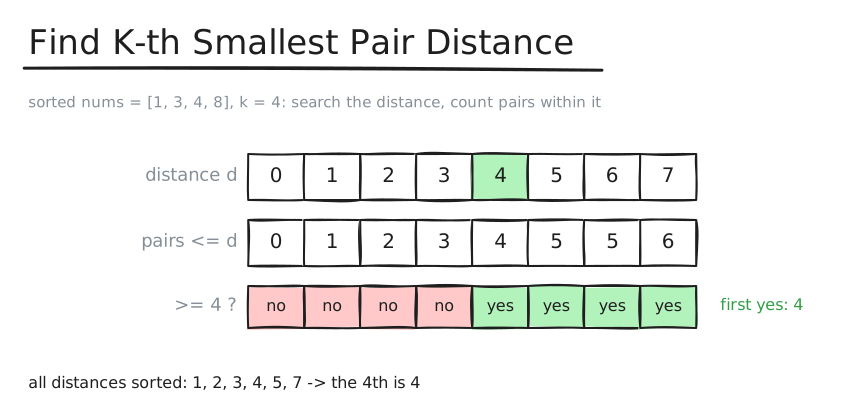
nums = [1, 3, 4, 8], k = 4 -> 4There are n(n − 1)/2 pairs — too many to list for n = 10⁴. Instead, ask how many pairs are at most d apart. That count only grows with d, so the answer is the first d whose count reaches k: binary search d between 0 and max − min. Counting is fast once nums is sorted: slide a window so its values span at most d; each new right end a[right] pairs with every value in the window, which adds right − left pairs. The left end only moves forward, so a count is O(n).
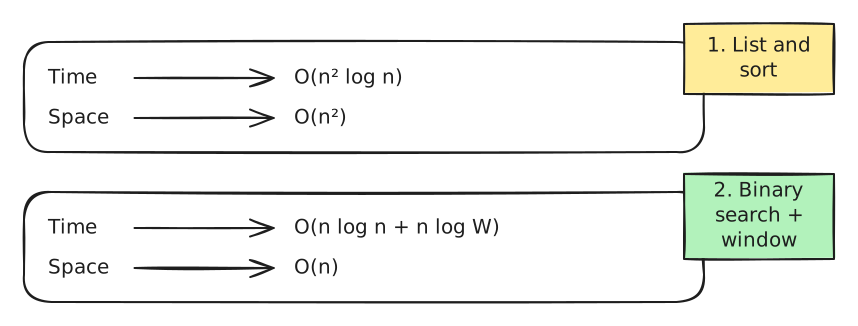
function smallestDistancePair(nums, k) { const distances = []; for (let i = 0; i < nums.length; i++) { for (let j = i + 1; j < nums.length; j++) distances.push(Math.abs(nums[i] - nums[j])); } distances.sort((a, b) => a - b); return distances[k - 1];}Time O(n² log n), space O(n²). Fifty million distances for n = 10⁴: too much memory and time.
For each candidate distance, a sliding window counts the pairs within it.
function smallestDistancePair(nums, k) { const a = [...nums].sort((x, y) => x - y); const countWithin = (d) => { // how many pairs are at most d apart? let count = 0, left = 0; for (let right = 0; right < a.length; right++) { while (a[right] - a[left] > d) left++; // shrink until the window spans at most d count += right - left; // a[right] pairs with every value in the window } return count; }; let low = 0; let high = a[a.length - 1] - a[0]; while (low < high) { const mid = low + Math.floor((high - low) / 2); if (countWithin(mid) >= k) high = mid; // at least k pairs within mid: the answer is mid or less else low = mid + 1; // fewer than k: the answer is bigger } return low;}Time O(n log n + n log W), space O(n) for the sorted copy, where W is the largest value. The answer is always a real distance: the first d whose count reaches k is the k-th distance itself. Use a 64-bit count — n = 10⁴ has about 5 × 10⁷ pairs, which fits an int, but bigger inputs wouldn't.
[1, 1, 1], k = 2 gives 0.min(x / i, n) per row.Was this helpful?
